The Psychology Behind Stereotypes in Indian Ads: Snickers, Apsara, and Godrej Expert | Lumir S Vinod
Here we are looking at three famous ads that perfectly used stereotypes already present in people’s minds, without raising any doubts, to promote their products to the audience.
Snickers Stereotype Ad
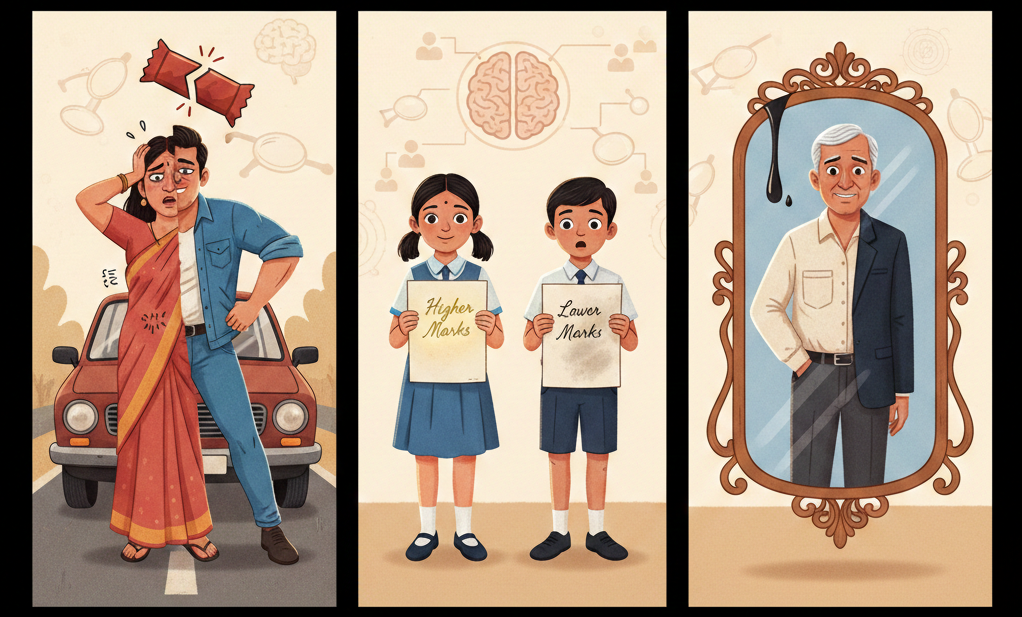
In it, the character is pushing a vehicle, but suddenly a heroine-like character says, “I can’t push this car; you guys can push it,” and her boyfriend-seeming guy says, “Hey, don’t act like this now.” Then they give him a Snickers, and he suddenly becomes a boy (back to a boy). In reality, he is a boy, not a girl, but acted like a girl when there was a problem because he was hungry. The ad is conveying the stereotype that girls can’t handle hard problems or that girly-like behavior is not suited for serious situations.
Here, they used the stereotype that women are not physically capable or act dramatically in serious situations to convey their message to the viewer. This exploits cognitive schemas and gender-based heuristics. Viewers have pre-existing associations between masculinity and physical strength or problem-solving ability. By showing someone acting “girlish” when hungry, the ad triggers instant recognition of this stereotype, creating humor and clarity in a short 25-second slot.
This stereotype has historical and social roots. Gender roles historically cast men as physically strong, protective, and solution-oriented, while women were expected to be delicate, nurturing, or dependent. Media perpetuates these ideas, repeatedly portraying women as less capable in certain domains, which strengthens cultural expectations and assumptions over generations.
Ads like this subtly reinforce assumptions about who can handle which tasks. For audiences, it can normalize expectations about gendered behavior, for example, “if someone struggles, it might be because of their gender.” Marketers use stereotypes to quickly communicate ideas. Here, Snickers leverages the “hungry = acting out of character” and gender-based expectations for comedic effect, while simultaneously promoting the product as the “solution” that restores normal behavior. The ad is designed for instant recognition, humor, and memorability, capitalizing on the viewer’s pre-existing schemas.
Link: https://www.youtube.com/watch?v=yf39vt0MKug
Apsara Stereotype
I watched an Apsara pencil ad where there are two kids, a boy and a girl. The boy showed his marks to the girl, which were 100/100. When asked, the girl didn’t show her marks, and her face looked sad. The boy took her paper and was shocked. Her mark was 105/100, which included 5 extra marks for her handwriting. This is an example of social cognition and cognitive bias, based on the stereotype that better handwriting comes from a good student and will lead to better marks. The main cognitive bias at work here is the horn effect, which occurs when we see one negative trait in someone and assume they possess other negative traits as well. The boy assumes that the girl scored fewer marks, and not only he but also we as the audience assume the same because her face looks sad.
Link: https://www.youtube.com/watch?v=KVVi7i0snkI
Godrej Expert Stereotype Ad
Today I watched an Indian hair dye ad by Godrej Expert. It features a wife and a husband where the husband’s hair is mostly white with some black strands, while the wife’s hair is “perfectly” black. She asks him to use hair dye, and he replies, who is going to look at him, and that he is just Madhavan and not the movie hero Madhavan. At that moment, the actor Madhavan appears and tells him that even if he is not a movie hero, he is still the hero of his wife and that personality is in the hair. At the end of the ad, he dyes his hair, and it turns black.
It is based on the stereotype that looks define personality or are associated with a person’s behavior.
The key psychological elements used in the ad are lookism or appearance bias and social comparison. The comparison with the movie star comes under upward comparison, and it is not for motivation but for insecurity. The transformation at the end implies that changing hair color leads to improved confidence, identity, and perceived personality, reinforcing the idea that self-worth can be enhanced through appearance.
Comments
Post a Comment